
Marine Hydrogenerators: How Charging Under Sail Works and How to Choose

A Remoran Wave 3 hydrogenerator delivers up to 300W as you sail, turning the water already flowing past your hull into charge for your batteries. No fuel, no engine running.
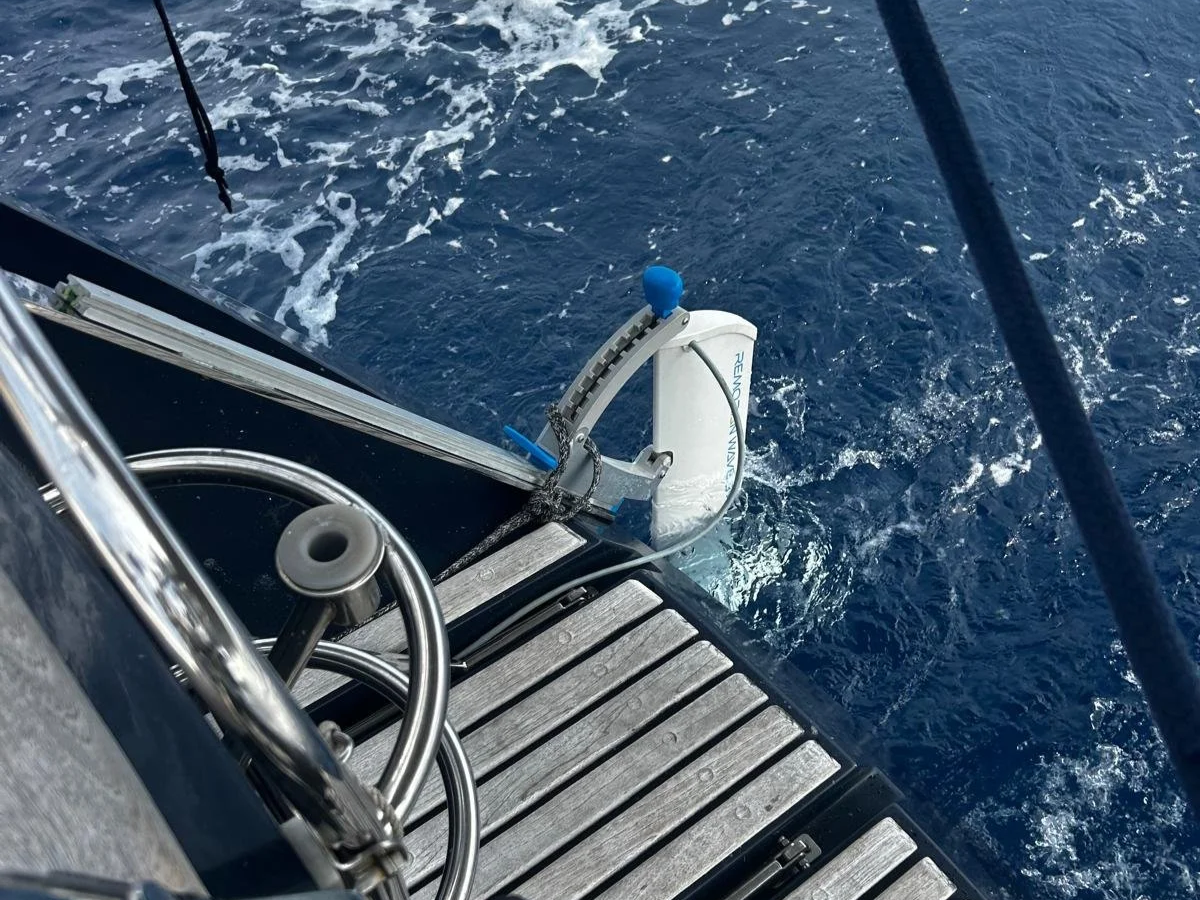
The unit is a 7.5 kg outboard turbine driven by a brushless, permanent-magnet rotor, lowered into the flow on the transom. The faster you sail, the more it makes, and the two Wave 3 models cover different speed ranges — the first choice to get right.
GS or GD: match the unit to how you sail
The Wave 3GS is built for cruising speeds, with an optimal range of 3 to 10 knots and a maximum of 12. The Wave 3GD suits faster boats, optimal from 5 to 15 knots and rated to 20.
Most displacement cruisers and steady passage-makers sit squarely in GS territory. Performance boats and multihulls that regularly hold higher speeds are the case for the GD.
You can compare them directly on the Wave 3GS and Wave 3GD product pages.
What a Wave 3 actually produces
Both models share the same ceiling: up to 300W, which is around 25A at 12V or 12.5A at 24V. Output builds with boat speed and depends on your installation and the flow over the turbine, so treat peak figures as approximate.
On a long passage that adds up. Mike Hutchinson's Oyster 53 Distraction ran a single Wave 3GS for a 31,000-mile circumnavigation, drawing around 90 to 100 amp-hours a day from the hydrogenerator alone on a 24V system.
He touched the unit just once in that time, to clear weed from the propeller. Mike calls it "one of the simplest and most effective upgrades we've made" — the full story is in Distraction's circumnavigation.
Does a hydrogenerator slow you down?
The honest figure, and the one Remoran publishes, is about 0.1 knots while charging — and only below hull speed. Once you reach hull speed the effect is no longer noticeable, and it falls further when the batteries are full or the cable is disconnected.
If you would rather lift it clear between charges, the EasyLift raises and lowers it from the deck at up to 10 knots.

How it charges your batteries
Every Wave 3 is supplied with the Remoran 300W charger, which detects whether your bank is 12V or 24V automatically. It runs smart charging profiles for lead-acid, AGM and lithium, so the output is matched to your batteries rather than forced at them.
You can watch live output from the Remoran app on a phone, in a Chrome browser, or on a Raymarine Axiom display. It is the feature owners mention most, because you can see exactly what you are making at any moment.
If you are planning a wider charging set-up, our chargers and power management range covers how the pieces fit together.
Where a hydrogenerator fits in your power picture
A hydrogenerator is supplementary charging, not a replacement for a generator. Its job is to keep the batteries topped up while you sail — which is often when solar and wind produce least.
It keeps making power at night, under cloud and when you are running downwind, so many cruisers run all three sources together. The engine or genset is then reserved for the jobs that genuinely need mains power.
Our solar, wind and hydrogenerator comparison weighs them side by side, and a power audit is the clearest way to see where a Wave 3 lands for your boat. Where you do need AC power, a marine generator does the different job.
Fitting it to your boat
The Wave 3 arrives as a complete package and mounts on the transom, with rail options to suit most stern shapes. On a sugar-scoop stern, or a boat without a swim platform, the bracket position is worth planning carefully — Richard Sharp's Walrus is a good example of getting that right.
AYS works through approved installation partners rather than fitting in-house, and every unit carries a two-year warranty with parts held in the UK. You can find a fitter through our approved installer network.
Choosing your Wave 3
If you sail regularly and want to lean on the engine less, the choice comes down to your usual speed: the Wave 3GS for cruising pace, the Wave 3GD for faster boats. Both make up to 300W from water you are already moving through.
Browse the full range on our marine hydrogenerators page, or get in touch about the right fit for your boat.