
Marine Air Conditioning: How to Choose the Right System for Your Boat
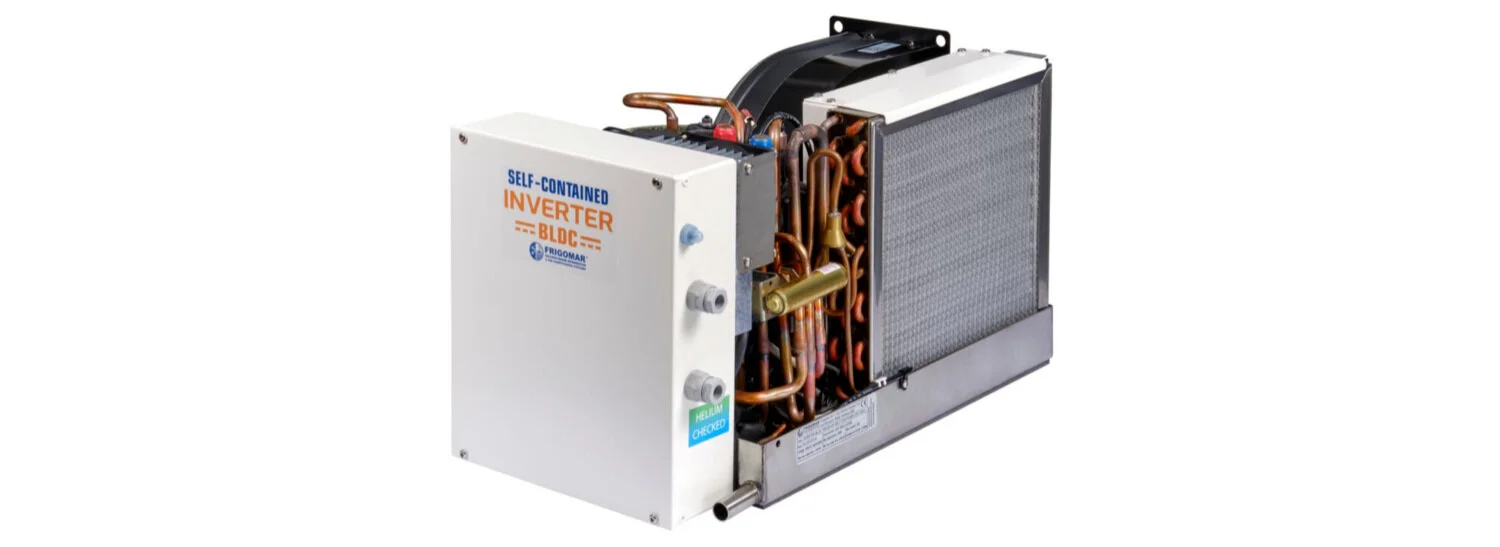
Marine air conditioning rejects its heat into the sea rather than the air. That single difference is why every installation runs on a seawater circuit: a through-hull, a strainer, a seawater pump, and a sealed loop.
Three decisions settle most of the choice, and the rest is detail. How much cooling each cabin needs, which system architecture suits the layout, and where the power comes from — taken in that order below.
Sizing: floor area, climate and glass
Sizing starts with the floor area of each cabin, not the whole boat, then adjusts for two things that change how hard that space is to cool.
The first is climate. A boat kept in the Mediterranean asks less than one in tropical or Gulf waters, where warmer air and sea push the cooling load up.
The second is glass. A cabin with only port lights takes far less cooling than a deck saloon with large windows, and an all-glass motorboat saloon sits at the top of the scale.
Hull length and boat type matter too, but they shape the shortlist rather than the load — the load comes from area, climate and glazing, worked out one cabin at a time.
Our marine air conditioning size calculator does exactly that: enter each cabin's dimensions, your climate and how glassy the space is, and it returns a BTU figure per cabin and a suggested system. That per-cabin total also decides the next question.
Self-contained or chilled water
Count the zones you want to cool, and the per-cabin figures point the way.
A self-contained unit holds the compressor, condenser, evaporator and seawater connection in one box, tucked under a berth or in a locker, with cooled air ducted to nearby outlets. Frigomar's self-contained units run from 7,000 to 24,000 BTU, and for one or two zones this is the most direct option: one box, one through-hull, one pump.
Air loses temperature and pressure down a long duct, so a self-contained unit cools the space around it well and is less suited to a cabin several bulkheads away. Once you want three or more independent zones, a chilled-water system fits better.
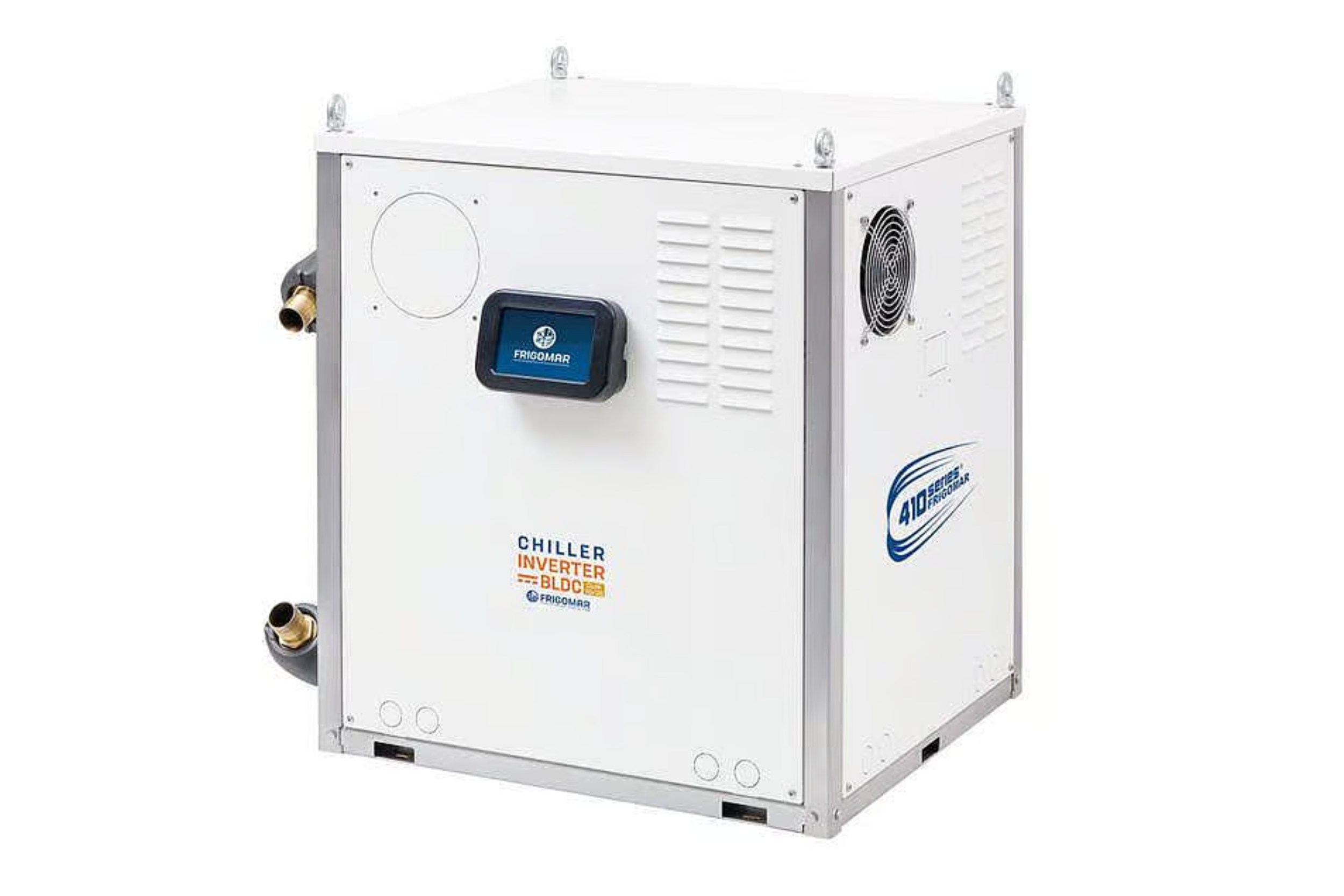
A chiller cools water centrally and pumps it through small-bore pipes to a fan coil in each zone, so the cold travels efficiently as liquid and every cabin keeps its own thermostat. Frigomar's chiller range spans 50,000 to 180,000 BTU, single or three-phase depending on model, and each system is designed around the specific boat — so it starts with a layout plan rather than an off-the-shelf unit.

Where the power comes from
Frigomar's variable-capacity units are efficient to power, drawing as little as 150W in ECO and starting without the surge of a conventional unit. That low, steady draw is the brand's defining feature, and it keeps both ways of powering air conditioning open to you.
The first is AC off a generator. A modern Paguro or Westerbeke set paired with a Frigomar unit is a common combination, and the low start-up current helps: the unit draws a maximum 2A on start against the 20–30A inrush of a comparable traditional unit, so the generator does not need oversizing just to swallow the surge.
Getting that generator sized correctly is its own job, so our guide to common generator sizing mistakes is worth a read if you are specifying both together.
The second is DC straight off the battery bank. Frigomar's DC models run on 24V or 48V, with 12V on the small frame, which suits boats that have moved to lithium.
In ECO mode the DC units draw from 155W on the small frame and 230W on the larger frame, low enough to run air conditioning for a few hours overnight on a strong lithium bank and recharge from solar, shore power or a shorter generator run. The AC units are comparably frugal in ECO, from 150W on the small frame and 200W on the larger.
That only works if the bank and charging are sized for hours of running, so it pays to audit your onboard power and match the battery bank to the job before you commit.
Heating from the same unit
If the boat sees use beyond high summer, reverse-cycle capability earns its place. The same refrigerant circuit that cools in July runs backwards to draw heat from the seawater and warm the cabin, which is more efficient than a resistive heater because it moves heat rather than making it.
Stable temperature and low running draw
A variable-capacity unit ramps its compressor to match demand rather than cycling fully on and off, which holds the cabin at a steady temperature and keeps the unit quiet once it has reached setpoint.
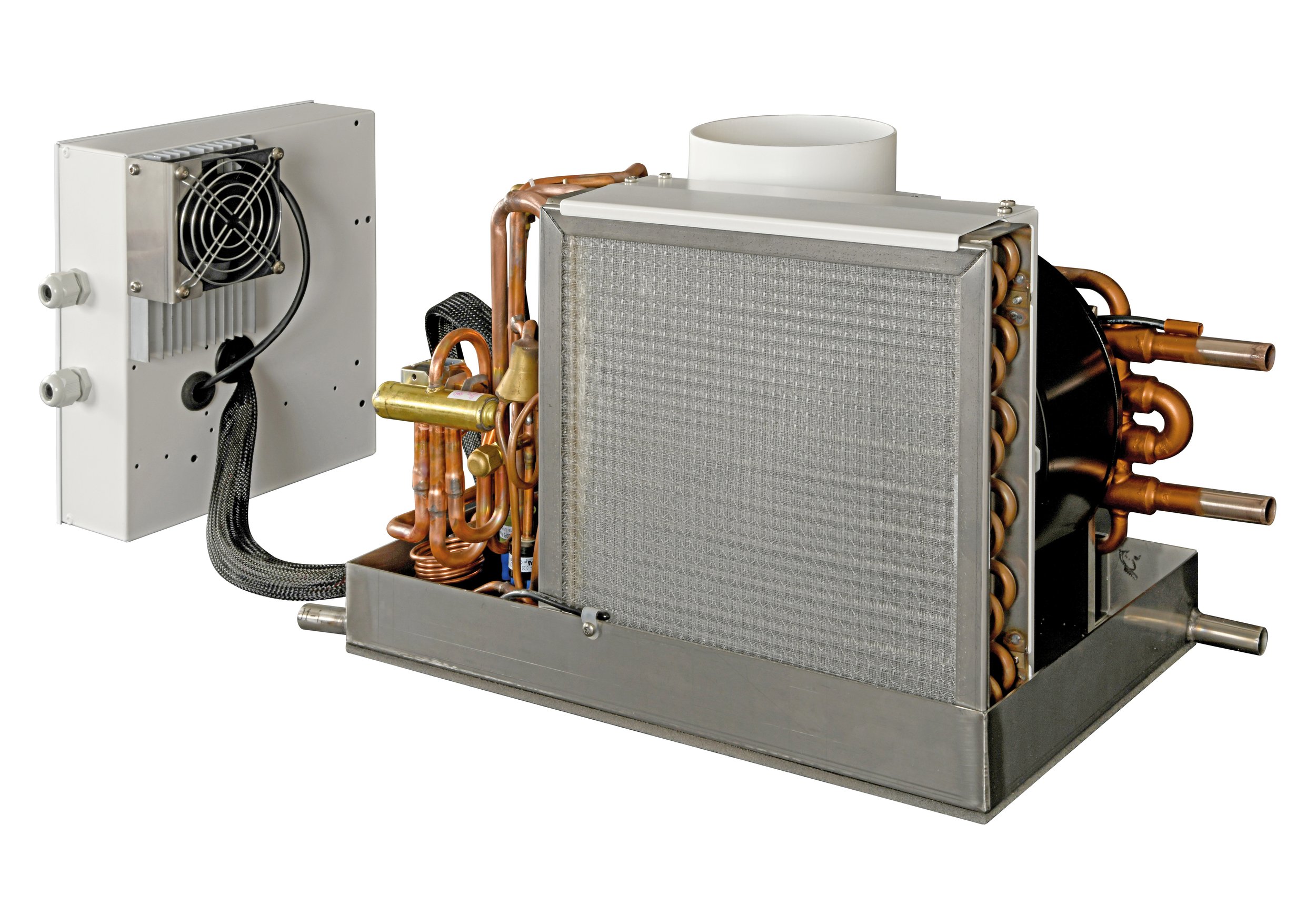
It is also efficient. Frigomar cites around a 50% reduction in seasonal energy consumption against an equivalent traditional air conditioner, which shows up as a smaller fuel bill on a generator and a slower drain on a battery bank.
Getting the installation right
Good seawater flow is what keeps the system running at its best, so the seawater circuit and a clean strainer are what a good install gets right from the start. A quick strainer check is also the simplest part of looking after it.
Every unit produces a little water as it dehumidifies, and the install routes that condensate to a drain so it clears on its own.
Getting these right first time is what a professional fit delivers, so this part of the job usually pays for one. The AYS approved installer network across the UK, Channel Islands and Gibraltar handles the through-hull and integration work most owners would rather not take on.
Putting it together
Size each cabin by its floor area, climate and glazing, decide whether one or two self-contained units cover your zones or a larger boat calls for a chiller, then settle the supply: AC from a generator you already run, or DC from a lithium bank for quiet running at anchor. Add reverse cycle if your season runs long.
For most cruising yachts, a variable-capacity self-contained unit in the right BTU bracket, fed from a sensibly sized generator or a strong lithium bank, delivers steady, efficient comfort. Run your cabins through the size calculator for a starting figure, then explore the Frigomar range or talk to us about your boat's layout and power setup.